

QUICK CALL
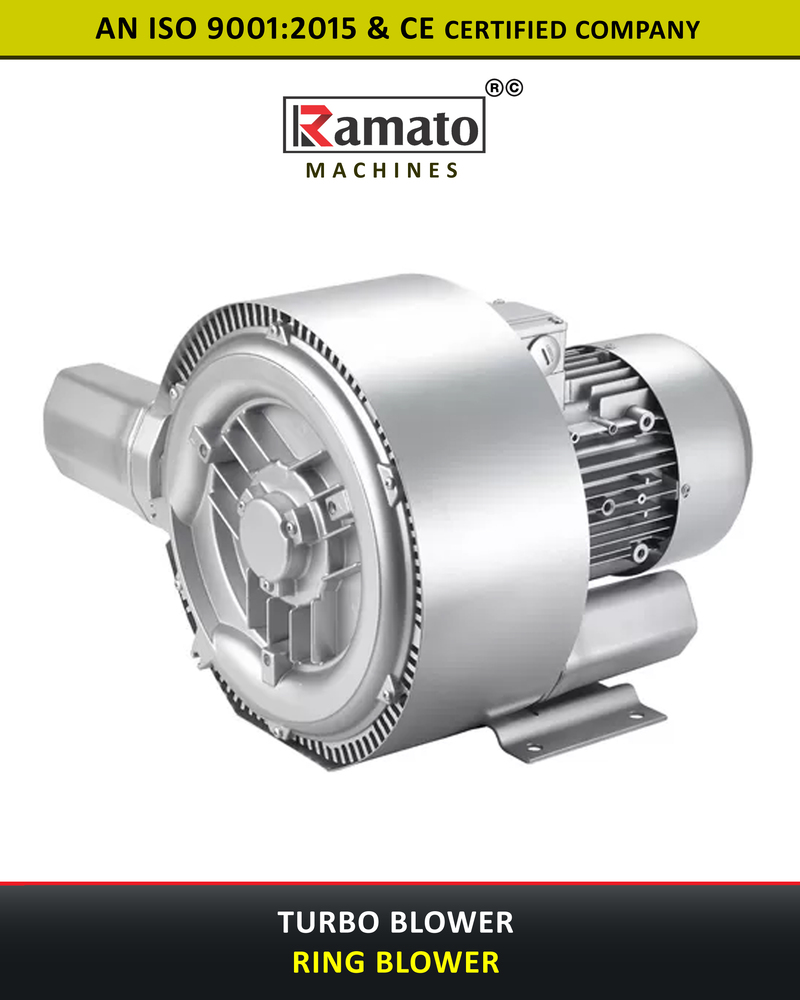
Side channel blowers consist of a ring-shaped housing. Ramato Side channel and the rotor opposite create a working area between intake and blow-out connections. The blade segments of the rotor suck the air and create radial pressure during turning. The centrifugal force causes the air to be pressed to the outside in the side channel. This creates a circular current between channel and blade segments. Due to the radial pressure, the air to be compressed in the chamber begins turning. The spiral swirling compresses the air several times and causes the pressure to rise. At the end of the chamber the compressed air is then pushed pulsation-free by the rotor through the blow-out connection. Ramato is Leading Manufacturer and Exporter of Hand Blower, Electric Blower, Air Blower, Ring Blower, Turbo Blower, Biofloc Blower, Ms Fabricated Blower and Centrifugal Fan Blowers From Rajkot Gujarat Bharat (INDIA).
Turbocharger Technology: The blower incorporates turbocharger technology, featuring high-speed impellers and precision engineering to generate large volumes of compressed air at high pressures efficiently.
High-Speed Operation: Operating at speeds of up to tens of thousands of revolutions per minute (RPM), the turbo blower generates high-velocity airflow for rapid air movement and efficient process ventilation.
Energy Efficiency: With its advanced design and variable speed drive (VSD) capabilities, the turbo blower achieves significant energy savings compared to conventional blowers, reducing operating costs and environmental impact.
Compact Design: The compact footprint of the turbo blower allows for flexible installation in tight spaces, maximizing floor space utilization and facilitating integration into existing industrial systems and processes.
Low Noise Operation: Despite its high-speed operation, the turbo blower is designed with noise-reducing features such as acoustic enclosures and vibration dampening materials, minimizing noise levels in the surrounding environment.
Built-in Redundancy: Some models of the turbo blower may feature built-in redundancy with multiple impellers or stages, ensuring reliable operation and minimizing downtime in case of a component failure.
Easy Maintenance: Designed for ease of maintenance, the turbo blower features accessible components and simplified service procedures, reducing downtime and ensuring maximum uptime for industrial processes.
Wastewater Treatment: Provides aeration for biological treatment processes such as activated sludge, aerobic digestion, and nutrient removal in wastewater treatment plants.
Pneumatic Conveying: Transports bulk materials such as powders, granules, and pellets in pneumatic conveying systems for industries including food processing, pharmaceuticals, plastics, and chemicals.
Industrial Process Air: Supplies high-pressure, high-speed air for process air applications such as pneumatic conveying, drying, cooling, and atomization in manufacturing and production facilities.
Power Generation: Assists in combustion air supply, flue gas desulfurization (FGD), and emissions control in power plants and industrial boilers.
Aquaculture: Provides aeration for fish farms, aquaponics systems, and other aquaculture operations to maintain dissolved oxygen levels and promote healthy aquatic environments.
Overall, the Turbo Blower offers a versatile and energy-efficient solution for industrial air handling and process ventilation, enabling enhanced performance, productivity, and sustainability across a wide range of industrial applications.
Features
Turbocharger Technology: The blower incorporates turbocharger technology, featuring high-speed impellers and precision engineering to generate large volumes of compressed air at high pressures efficiently.
High-Speed Operation: Operating at speeds of up to tens of thousands of revolutions per minute (RPM), the turbo blower generates high-velocity airflow for rapid air movement and efficient process ventilation.
Energy Efficiency: With its advanced design and variable speed drive (VSD) capabilities, the turbo blower achieves significant energy savings compared to conventional blowers, reducing operating costs and environmental impact.
Compact Design: The compact footprint of the turbo blower allows for flexible installation in tight spaces, maximizing floor space utilization and facilitating integration into existing industrial systems and processes.
Low Noise Operation: Despite its high-speed operation, the turbo blower is designed with noise-reducing features such as acoustic enclosures and vibration dampening materials, minimizing noise levels in the surrounding environment.
Built-in Redundancy: Some models of the turbo blower may feature built-in redundancy with multiple impellers or stages, ensuring reliable operation and minimizing downtime in case of a component failure.
Easy Maintenance: Designed for ease of maintenance, the turbo blower features accessible components and simplified service procedures, reducing downtime and ensuring maximum uptime for industrial processes.
Applications
Wastewater Treatment: Provides aeration for biological treatment processes such as activated sludge, aerobic digestion, and nutrient removal in wastewater treatment plants.
Pneumatic Conveying: Transports bulk materials such as powders, granules, and pellets in pneumatic conveying systems for industries including food processing, pharmaceuticals, plastics, and chemicals.
Industrial Process Air: Supplies high-pressure, high-speed air for process air applications such as pneumatic conveying, drying, cooling, and atomization in manufacturing and production facilities.
Power Generation: Assists in combustion air supply, flue gas desulfurization (FGD), and emissions control in power plants and industrial boilers.
Aquaculture: Provides aeration for fish farms, aquaponics systems, and other aquaculture operations to maintain dissolved oxygen levels and promote healthy aquatic environments.
Overall, the Turbo Blower offers a versatile and energy-efficient solution for industrial air handling and process ventilation, enabling enhanced performance, productivity, and sustainability across a wide range of industrial applications.
| MODEL | POWER | DISPLACEMENT | VACUUM | PRESSURE | PRESSURE PSI | SOUND | WEIGHT |
| RTD_DS-88 | 1 HP | 88 M³/hr/52 CFM | 210 mbar | 240 mbar | 3.48 PSI | 55 DB | 14 KG |
| RTD_DS-150 | 2 HP | 150 M³/hr/88 CFM | 280 mbar | 280 mbar | 4.06 PSI | 66 DB | 24 KG |
| RTD_DS-150V | 3 HP | 150 M³/hr/89 CFM | 330 mbar | 440 mbar | 6.38 PSI | 66 DB | 27 KG |
| RTD_SS-230V | 3 HP | 230 M³/hr/135 CFM | 290 mbar | 360 mbar | 5.22 PSI | 72 DB | 35 KG |
| RTD_SS-230 | 4 HP | 230 M³/hr/135 CFM | 340 mbar | 410 mbar | 5.94 PSI | 72 DB | 39 KG |
| RTD_SS-230P | 5 HP | 230 M³/hr/135 CFM | 390 mbar | 490 mbar | 7.1 PSI | 72 DB | 45 KG |
| RTD_SS-320V | 7.5 HP | 320 M³/hr/188 CFM | 440 mbar | 500 mbar | 7.25 PSI | 73 DB | 70 KG |
| RTD_SS-320P | 10 HP | 320 M³/hr/188 CFM | 440 mbar | 570 mbar | 8.26 PSI | 73 DB | 77 KG |
| RTD_SS-520 | 15 HP | 520 M³/hr/317 CFM | 430 mbar | 660 mbar | 9.57 PSI | 74 DB | 123 KG |
| RTD_SS-1110P | 27 HP | 1110 M³/hr/653 CFM | 440 mbar | 500 mbar | 7.25 PSI | 74 DB | 204 KG |
| RTD_SS-1110HP | 33 HP | 1110 M³/hr/653 CFM | 440 mbar | 590 mbar | 8.55 PSI | 74 DB | 211 KG |
| RTD_SS-2050 | 27 HP | 2050 M³/hr/1206 CFM | 250 mbar | 230 mbar | 3.33 PSI | 75 DB | 230 KG |
| RTD_SS-2050P | 33 HP | 2050 M³/hr/1206 CFM | 310 mbar | 280 mbar | 4.06 PSI | 75 DB | 235 KG |